Friday, March 4, 2011

Pictures of the internals

Here are a few of the pictures of the internal workings of the SR22.

The parachute, also know as the Cirrus Airframe Parachute System (CAPS™).


This is an inside look at the tail. It's cool to see how the carbon fiber/composite is formed.


This is the mechanical portion of the rudder and elevator assembly in the back of the aircraft.


Inside of the wing assembly.


The nose gear assembly. The big black bumper is the shock dampner for the nose gear assembly.

My First Owner Assisted Annual


After much research I decided that I would do an owner assisted annual on my 2004 SR22. I am a very meticulous person and pretty mechanical, so working on the plane really hasn't been all that big a deal. As it is, I do all the maintenance that I can legally get away with according to the FARs. I have a very competent mechanic (Glen) and he is pretty good about teaching me the aspects I need to do my part and by doing it myself it would save me a TON of money. In my area (Kansas City) there are only a couple Cirrus Certified Service Centers and all of them charge a flat rate of around $2400, just to inspect the aircraft. This does not include working on anything they find, but only on taking the plane apart, inspecting it, checking for ADs and SBs and put it back together. This is VERY pricey and quite frankly a rip off, because disassembly of the aircraft is really quite simple.

For my inspection, my mechanic and I looked over the Cirrus Maintenance Manual (CMM) and used the check list to determine what tasks were mine and what were his. We started out by conducting a before maintenance check of the aircraft where we started it up and ran the engine to test different aspects from fuel flow, to sensor readings to brake performance. One of the test was to go full throttle on the ground, which took both of us to stand on the breaks to ensure that we didn't move. With 310HP, it was damn near impossible to keep it from moving. The brakes held, but barely!

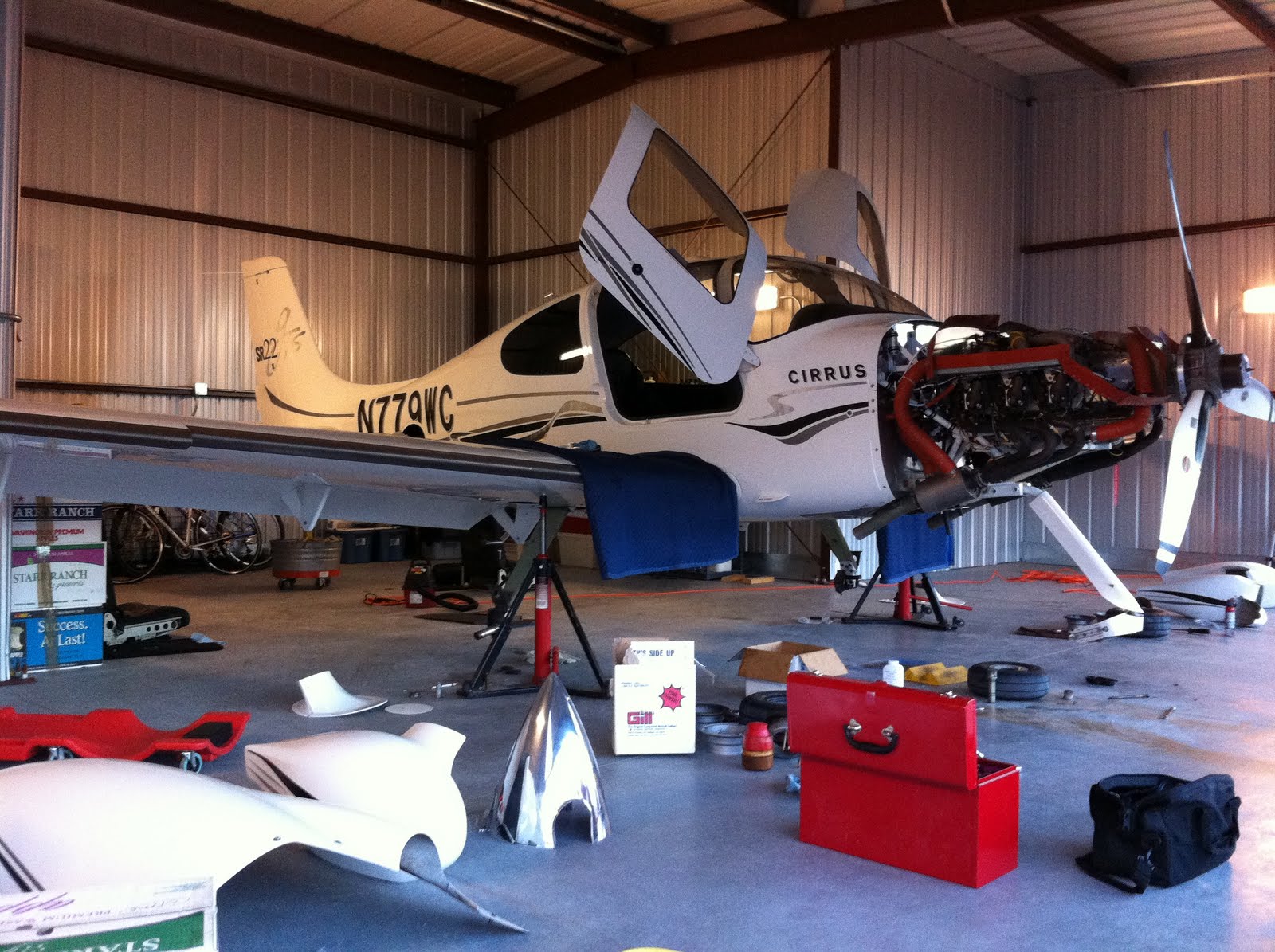
After Glen was happy, we then put it back in the hanger and I began to take apart my items. My focus was to take off the entire cowling, wheel pants, inspection covers all around the aircraft, and to completely remove all the seats, carpet, and inside inspection panels. I also changed the oil, removed the battery starter (I was having some issue with it, so Skytec told me to send it back since it was under warranty, and alternator #1. My alternator had been giving me some issues, so I had to get that off to send in and get repaired. All of this took me approximately 15 hours, although I think I could do it much faster the second time and also if I wasn't jaw jacking so much with everyone that stopped by.

Once it was all taken apart, Glen pulled out a flashlight and started checking everything out. After his inspection was complete, he then went around and greased everything that needed to be greased, put in some new sparkplugs, repacked my wheel bearings, flipped my main tires and put in new tubes (old ones had some creases that would become leaks). Glenn also did a compression test and we got #1-77/80, #2 77/80, #3 76/80, #4 70/80, #5 77/80, #6 77/80. Being that all my compressions are in the high 70s, my engine is doing good. My #5 exhaust valve seemed to be leaking a little, hence the 70/80, but when we reviewed the engine log books, we found that it had been 70/80 since the day it came from the factory and I haven't had any issues after 873.1 hours, so my mechanic said not to mess with it and keep running it. On another positive engine note, Glen told me that he was absolutely amazed at the condition of my engine. He said that he had never seen an engine before that was consistently leaned out and run at LoP (Lean of Peak). My engine had zero, zilch, none, nadda carbon or lead build up at all! In fact the insides were so clean, that you could literally read the serial numbers off of the pistols! He said that most the of the engines he works on are flight school engines, but he had never seen any engine this clean. It just goes to show you that if you run your engine properly and use the LoP methods, it will greatly reduce the wear on the engine. From much of my research, most Continental IO-550Ns like mine have very low compressions (50-60s) at this point and as they approach 1200 hours they are needing new cylinders. My appear to be running as strong (actually stronger) than when they were brand new. Hopefully this trend will continue!

The process of doing this annual has taken a pretty good chunk of time over numerous days. There have been delays since my mechanic has been sick and because I have had to wait on my alternator and starter to return. The only real squawk that we found was I had were two "T" fittings on the TKS system that appeared to be leaking. These we will have to disassembled and replace the o-rings and reassemble to fix. We are putting this off until we get the alternator back and reinstalled to verify exactly where the leak is coming from before we get too carried away. If we were to buy the parts from Cirrus, they would $57.16 for each "T" fitting, when all we will probably have to do is take them apart and fix the o-rings.

Other than fixing these fittings, the only other thing I had to do was replace two tubes in the main wheels, replace the spark plugs since the original Fine Wire Champion spark plugs had almost 900 hrs on them which is high and they can be prone to cracking and breaking, so I thought I had pushed them long enough. I also had to replace eight D-cell batteries in the ELT and Glen fixed a leaking valve gasket, but that was it. Now weather permitting (we just had a cold spell and more snow) and parts returning, we can start to put it all back together!

Sunday, February 20, 2011

Cirrus vs Corvalis/Columbia


There seems to be much debate over safety concerns for the Cirrus Aircraft. There area couple of bloggers that are out to bad mouth Cirrus and claim that the Cessna Corvalis/Columbia aircraft are far safer and easier to fly. It should also be noted that both bloggers are salesman for Cessna (go figure) and are using fear to try to sell their aircraft. Since Cessna has purchased Columbia, they have since stopped production of the 350 and now only sell the 400TT and at that are having a tough time making it. Cirrus on the other hand is the number one selling GA aircraft in production and is still selling lots of aircraft (even though the economy has been poor!).

One of my COPA members compiled these statistics gathered from a friend's Corvalis/Columbia membership and compared them to the Cirrus. It should be noted though that it is hard to do much weighted analysis based on these numbers because the Corvalis/Columbia is about 1/3 the size of the Cirrus fleet. Pilot Error is comparable in both fleets, however Corvalis/Columbia seemed to have had more mechanical problems. They've also had less problems weather, cruise flight and pilot decision making. Surprisingly they have more problems with landing than the Cirrus fleet, which is unique in that many blogs post just the opposite.

In a survey done last year, Corvalis/Columbia pilots fly 150-160 hours per year. This is similar to the 146.5 hours per year estimated for SR20 and 161.5 hours for SR22 pilots.

CAUSE OF ACCIDENT/INCIDENT

Sunday, February 13, 2011

Electrical Failure!

Yesterday 12 FEB 2011, I went on a flight with my friend Frank to practice some instrument approaches, pick-up some oil and have breakfast in St. Louis. When I started up my plane, I had an "low voltage" annunciator light come on and my Essential Bus, showed "red" on my MFD. When I looked at my analog gauges, all was normal. After giving it about 60 RPMs everything turned back to normal and the annunciator light turned off. During run-up everything was normal, so I then proceeded to fly over the Sherman. I picked up Frank and then we took off and I picked up my IFR clearance in the air and headed for Columbia, MO. Periodically I would get a low volt/ALT1 or ALT2 annunciator light and sometimes my Main Bus would light up yellow on the MFD. I have had this happen a few times and my mechanics all seem to think I have some sort of loose wire someplace. My annual is coming up in a few weeks, so we would figure that out then. I shot the GPS RW20 approach, went missed and entered the published hold. After two turns we left the hold on vectors for the ILS RW30 at Jefferson City, MO. Enroute my analog engine gauges started bouncing and then my MFD started to flicker and eventually went out. Shortly there after my NAV/COM#2 went out as well as my TCAS, Terrain, XM, Stormscope, and Transponder. I then cancelled IFR (it was severe clear anyway) and asked for direct to KJEF. Then I realized I lost my fuel gauges, trim and flaps as well. Flying a plane with no trim really sucks to say the least. The tower than proceeded to try to get me headings to a different runway and I had to get direct for RW30 since I just wanted to get the plane on the ground and because I was coming in a bit fast since I had no flaps and wanted the 6,000' runway. The landing was fine, probably a bit too fast and I used basically all 6,000feet to be easy on my brakes (which were hot and mushy at the end) and I taxied over to the FBO. We spent the rest of the day trouble shooting all sorts of stuff and we were lucky that there was a mechanic that was working on his own plane and happened to be very familiar with Cirrus (he had basically the same plane). He and a couple of my COPA buddies on the phone had us check all sorts of stuff. We think that I have either a bad Alternator 1 or a voltage regulator in the MCU (Master Control Unit - the box that controls all the glass avionics). We recharged the battery (which was dead), pulled all the non-essential circuit breakers and flew her back to Kansas City VFR with no issues. I'm just glad we were not in IMC!

Overall it was a great learning experience since now I know exactly what to look for and expect in the event of another electrical issue like this. The redundancy of the aircraft avionics works as advertised. I assumed that my light issue was just a loose wire as my mechanics though since the analog gauges were all showing normal readings. Little did I realize that my battery was taking the entire load until it couldn't support the main electrical bus anymore and shut it down. Basically all I had was the essential bus (PFD, analog flight gauges and NAV/COM #1). The other lesson here is that if you lose your Main Bus, you lose flaps and trim! Now the fun part begins of trying to figure out what heck to do next. Oh the life of aircraft ownership :-)

This would be my second inflight event that I have had to deal with. The first was when my landing gear lever died on my Piper Arrow and I had to do an emergency extension to get them down.

Thursday, February 10, 2011

Flying with Children


There are many thoughts and opinions on flying with children. Just like everyone else, I have my own opinions on this topic. I have two kids, a four year old and a six month old infant. Both have flown a lot with us, all over the country and seem to have loved every minute of it. Flying with children takes a little planning and preparation to make it all work out. There are several issues that need to be worked out for them so that it is safe and fun. The first one is seating.
Most car seats will fit inside an airplane, but you need to test this out before you actually attempt to go someplace. We have several car seats and I have found that one of them works better than the others because it doesn't have a wide base and it is also adjustable for angle. This allows us to strap it in the rear seat and provide a comfortable "perch" for my son to fly. Now that he is four, we have actually purchased him a booster seat and I have put him in the front passenger seat and this seems to work fairly well. You just need to make sure that the child cannot reach anything that could cause and accident, like say the fuel mixture lever or yoke! For my infant, we tried to put him in a car carrier and put it in the back seat, but he didn't like it, so we bought a chest harness and he flew on mommy's chest. Some might frown upon this, but it was the only way that my wife had total access to him. If doing this though, you need to make sure that the passenger's seat belt goes UNDER your child, so that he wouldn't get squished in an accident.

The next important thing to think about is hearing protection. This is extremely important since airplanes are very noisy. When I first son was 2-3 years old, we used some small shooting earmuffs from a sporting goods store. Although he couldn't talk to us, his ears were protected. Now that he is older he wears a set of Bose-X and has learned to only pull the mic down when he needs something. For babies, this is really hard because no one makes earphones small enough for infants. If you google flying earmuffs you will find examples of homemade solutions like winter earmuffs and wrapping gloves over their ears and covering with a hat and all sorts of stuff. We were able to get my shooting ear muffs to work, but then again he was on my wife's chest and she was able to keep his head supported. If he would have been in a car carrier, this probably wouldn't have been possible.
There are also several other tricks that can really help your infant (and wife) enjoy the trip as well. First trick is to have a bottle ready for them as soon as you start your take off roll. The sucking action on the bottle will help them keep the pressures down in their ears and make it a much more enjoyable flight for all. We also did this on descent as well. I also found that if you add "Baby Tyler on board, gradual climbs and descents required" in your remarks box of your flight plan, the controllers will assist you greatly. On several occasions we have actually been asked by ATC "How's Tyler doing?" which is pretty cool! When doing your flight planning, it is important that you stay at or below 8,000 feet. The pressures higher than this is too hard on their little ear drums and at younger ages this can be very painful for them. Normal airlines pressurize their cabins to around 8,000 feet even though they are at 30,000 feet and kids fly on airlines all the time with no issues. If you keep it at 8,000' or less, and climb or descend at 300-500' FPM they will be just fine.

Although as pilots we all love to just fly. Most pilots eat, sleep and breath flying. Kids love to fly too, but after a little while they get bored and antsy. We have found that bringing a portable DVD player or a small game system/iTouch are absolute life savers.
My son will sit and watch movies or play with his iTouch for most of the flight, which makes life much easier on mom and dad. Personally I think the iTouch is perfect because you can put App games, movies or music on it to keep them occupied for hours. Their battery life is also pretty good and they don't take up much room. My wife is also really good about bringing along small snacks. This also helps occupy time and keeps the kids happy.

The last tip on flying with children is to make them go potty just before getting on the airplane. Most of our GA aircraft don't have any kind of potty and there is just no way to relieve themselves once flying. They may feel they don't have to go, but if you don't make them go, then they will have to go about 20 minutes after take-off. When my first son was 2-3, we always just put a pull-up on him, so that if he had an accident it really wasn't going to be an issue.
Overall traveling with children is a lot of fun. If you take the time to plan and prepare for it, the entire event will be fun for everyone. Before trying a long cross country, try a short flight first to work out the bugs in your plan. Something will always pop up and if you do this, you won't mess up an important family vacation or business trip. Last summer I took my wife, toddler son and infant son all the way from Kansas City to Watertown, NY and then on to Maine and the Hamptons and then all the way back to KC. We spent some pretty long legs in the Cirrus, but because of our planning and preparation, it was a great trip for all.

Wednesday, February 2, 2011

Simulators for Flight Training


As a pilot and a Simulations guy at work, I believe that using flight simulators is extremely important! Simulators allow students to get better (and cheaper) use of their time and instructors can replicate emergency procedures and weather variations without putting students at risk. Although it should be noted that not all flight training can be done in a simulator and there is also something to be said for "the real thing." One great use that I have found for simulators is Instrument Training. I spent countless hours at home on my PC using Microsoft Flight Simulation X when I was working on my Instrument ticket. Even my instructor noticed how much quicker and more precise I was grasping the training than prior students. Now keep in mind that I also have a CH Yoke and Pedal system (about $200), but this makes the entire experience so much more realistic. I also purchased a book called Microsoft Simulator X for Pilots - Real World Training ($16-20 on Amazon). This is a fantastic tool for working on your flight training, especially for instrument work. It has lots of preset conditions that all you have to do is load it up and execute the training chapter. I found this to be a lot of fun, but also helped to bring up good questions to ask my instructor about. There are some limitations to using FSX and a real training simulator is an even better option, but I really got a lot out of my FSX. It is a great tool, but it is limited on what it can be used for to replicate actual training. Using it the wrong way can also instill bad habits or allow for negative training that can hurt your flight training. I would recommend discussing any simulator with your flight instructor and get their thoughts on what to use or not to use.

What started this posting, was a posting by our COPA safety guy Rick Beach about flight simulators for Cirrus aircraft. As it turns out there are far more of them than I had ever expected (See Below). These simulators are great and the one's that can replicate CAPS simulation are even better. I'm really hoping to try one of these this summer and to get some really good emergency training under my belt.


Sunday, January 23, 2011

Home for Christmas


One of the great benefits to owning an aircraft or even just being a pilot and renting an aircraft, is the ability to save time. For me as a military member, I am relocated every three to four years and because there are no active duty installations in Minnesota, we will never be close to the family. This means that as a family we normally only get to come home and see the family once or twice a year because it's a painful 12-hour drive by car or the airlines gouge us for so much money, that we just can't afford it. besides, taking young kids (4yo and 5mo) on an airline trip is crazy today with all the painful security measures, not to mention the horribly rude airline service that is now the norm today.

By owning our own aircraft we now have the ability to fly to Minnesota and it generally takes only about 2:15 depending on the winds. This is FAR better than a 12-hour drive and significantly cheaper than flying commerical. We also can also leave on our own schedule (weather permitting) and my wife can carry whatever bottles of stuff she wishes since we don't have to deal with the TSA security. Oh and we also don't have to radiate or let strangers fondle our children!!

So this year we decided that we would celebrate Christmas morning at home and let the kids open presents and play, then on the 26th, we would fly to MN for a family dinner. We originally were supposed to go on the afternoon of the 25th, but I didn't want to take any chances with potential icing because of all the snow storms taking place in Iowa and Minnesota.

We departed late afternoon and our flight was uneventful. As we approached Brainerd we had overcast skies with 500' ceilings and tops around 2900'. We received vectors for the ILS RW23, which we had to shoot twice because of close vectoring by ATC and I was not able to get a good set-up for the approach. The picture of the cockpit (although kinda blurry) was taken by my wife just before we descended into the clouds. Not the CMAX (electronic approach charts on the MFD screen. This is just one of the many reasons why I love this aircraft! The second approach went off without a hitch and we landed safely at Brainerd.

After a few days of visiting family we hopped back in the plane and flew back home. Once again a really nice trip and a beautiful sunset. This has been only one of the trips we have had the privilege of taking in the plane and it has helped us to visit our family a lot more, which is important because we want our children to grow up begin able to know their grandparents, uncles and cousins. Without the plane there would be far fewer trips, since it just isn't possible to drive.